White exhaust smoke after startup may be harmless water vapor on a cold morning. If it remains after warm-up or comes with rough running, it may signal unburned fuel or coolant. At Saville’s Service Center, we help separate condensation from a fault that needs testing.
Our diesel engine repair covers excessive smoke, fuel injectors, glow plugs, fuel systems, EGR components, and turbochargers. Smoke color is only a clue; testing must identify the cause.
When White Exhaust Smoke After Startup Is Normal
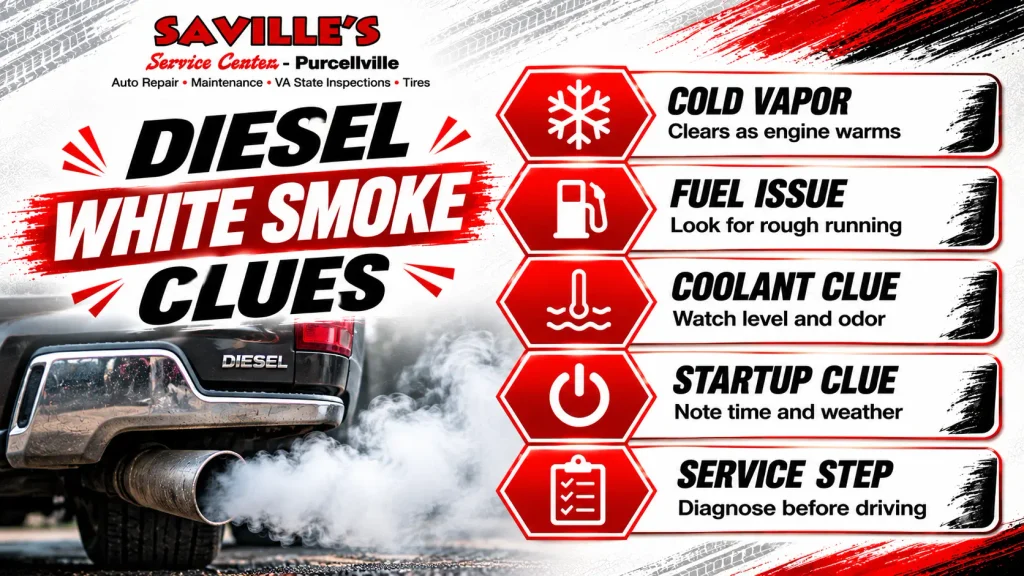
A thin cloud that fades quickly can be normal condensation. Cooler air makes water vapor visible, while engine heat should clear it.
Cold-Weather Water Vapor
Diesel exhaust contains water vapor. On cold Western Loudoun mornings, it can condense and appear white at startup. The cloud should lighten as the exhaust warms.
Short trips around Purcellville, Round Hill, or Hamilton can leave more exhaust moisture because the system may not fully warm. That pattern alone does not prove a fault.
Signs the Smoke Is More Than Condensation
Smoke needs a closer look when it stays dense after warm-up, returns during acceleration, or has a fuel-like or sweet odor. Rough idle, hard starting, coolant loss, or rising temperature add useful clues.
Record the temperature and how long the smoke lasts. A startup video can help if the symptom fades before the vehicle reaches the shop.
Diesel White Smoke Causes to Check
Persistent white smoke usually means fuel is not burning completely or coolant is reaching the combustion chamber. Low compression and timing faults can also prevent clean combustion.
Fuel That Does Not Burn Completely
Cold cylinders may not ignite injected fuel well. Weak glow plugs, a failed glow plug control circuit, incorrect injection timing, or low cranking speed can leave a pale cloud that smells like diesel.
Diesel injector problems can create a similar result. An injector may leak, stick, spray poorly, or deliver the wrong amount of fuel, causing shaking, knocking, or hard starts.
Coolant Entering the Combustion Chamber
Steady white exhaust with a sweet odor can point to a coolant leak in diesel engine passages. Possible paths include a failed head gasket or cracked cylinder head.
Do not open a hot cooling system. Check the reservoir only when the engine is cool and note any level loss or overheating. Our engine repair team handles coolant leaks and head gasket failures.
Low Compression or Incorrect Timing
Diesel combustion depends on compression heat. Worn cylinders or valve sealing problems can reduce that heat and leave fuel partly burned.
Incorrect injection timing can also change smoke, sound, and starting behavior. Scan data and mechanical tests should confirm timing or internal wear.
Clues That Help Narrow the Cause
The most helpful clues are smoke duration, odor, engine sound, temperature, and fluid changes. No single observation confirms the failed part.
Smell, Engine Sound, and Smoke Duration
A sharp raw-fuel smell may support an incomplete-combustion concern. A sweet odor can suggest coolant, though smell is subjective and should not replace testing.
Note whether the engine idles unevenly, knocks, loses power, or smooths out when warm. Our Ford truck and car repair team uses model-specific checks rather than one diagnosis for every vehicle.
Coolant Level and Temperature Changes
Coolant loss without an external leak raises concern about an internal path. Temperature spikes or reservoir bubbling add context but do not confirm the cause.
Avoid repeated cold starts simply to watch the smoke. Extra unburned fuel can dilute engine oil or place more fuel into the exhaust system.
How Technicians Diagnose Persistent White Smoke
Diagnosis starts by reproducing the condition and separating fuel, cooling-system, and mechanical causes. Replacing injectors based on smoke color alone can miss the actual fault.
Fuel-System and Injector Checks
A technician may review fault codes, coolant temperature, glow plug operation, cranking speed, fuel pressure, injector balance, and return flow. Electrical tests can reveal a cold-start circuit fault.
Fuel quality and service history matter too. Contaminated fuel or air in the supply side can change the testing path.
Cooling-System and Mechanical Tests
Cooling-system pressure, combustion-gas, compression, or cylinder leak-down tests may be appropriate. The sequence depends on the engine and initial findings. Results should be compared with coolant loss, smoke behavior, and engine data before major parts are authorized.
When to Stop Driving the Diesel
Stop the engine if white smoke is heavy, coolant is dropping quickly, the temperature rises, the engine knocks, or power falls sharply. Arrange towing when continued driving could overheat the engine or send excess fuel into the oil and exhaust.
If smoke is light but persistent, avoid pulling a trailer or taking long trips until the vehicle is checked. During cold weather, review Virginia winter road conditions before arranging a trip or tow on Route 7.
Takeaways
A brief cold-start cloud can be normal condensation. Smoke that remains after warm-up, smells unusual, or comes with rough running needs diagnosis. Useful clues include smoke duration, temperature, coolant level, and engine sound. Testing should separate fuel, compression, timing, and cooling-system faults.
Frequently Asked Questions
Is white smoke normal when a diesel first starts?
Yes, a light white cloud can be normal when a cold diesel starts. It should fade as the exhaust warms without coolant loss or persistent rough running.
Can bad glow plugs cause white smoke after startup?
Yes, weak glow plugs or a control fault can leave fuel unburned during a cold start. Testing can identify the failed plug, wiring, relay, or controller.
Does white diesel smoke always mean a head gasket failure?
No, white diesel smoke does not always mean the head gasket failed. Condensation, injector trouble, low compression, or incorrect timing can produce a similar cloud.
Why does my diesel run rough while producing white smoke?
Rough running with white smoke often means a cylinder is not burning fuel completely. Injector faults, weak glow plugs, low compression, air, or coolant may be responsible.
Is it safe to drive a diesel that keeps smoking white?
Only for a short drive, and only when smoke is light, temperature is normal, and coolant is stable. Stop and arrange towing if smoke becomes heavy or the engine overheats or knocks.
Schedule Diesel Smoke Diagnosis in Purcellville
For diesel repair in Purcellville, VA, our team can test the fuel, glow plug, cooling, and mechanical systems behind white smoke. We service diesel vehicles across Purcellville and Western Loudoun.
Call (540) 338-5749 to schedule a diagnosis, or visit 37251 E Richardson Ln, Unit B, Purcellville, VA 20132. Tell us how long the smoke lasts and whether the engine runs rough or loses coolant.