
A car hesitates when accelerating when the engine or drivetrain cannot respond smoothly to your request for power. The cause may not turn on a warning light right away, but the delay still deserves attention.
At Saville’s Service Center, our engine diagnostic service can check live operating data and test the systems involved. This allows us to diagnose the hesitation without relying on a dashboard warning light alone.
Why a Car Can Hesitate Without a Warning Light
A case of engine hesitation without a warning light often means the problem has not met the computer’s threshold for storing a fault code. Some faults happen only under a certain load, temperature, speed, or throttle position. A sensor can also send a value that looks possible to the computer but is still inaccurate enough to affect performance.
A scan is only one part of a complete diagnosis. Understanding how a vehicle diagnostic test works shows how codes and electronic data guide testing. When no light is on, a technician may need to compare live data, measure fuel pressure, inspect ignition output, and road-test the vehicle.
Common Causes of Acceleration Hesitation
The most common causes of acceleration hesitation involve fuel delivery, airflow, ignition, or the transmission. The way the symptom begins can help narrow the list, but testing is needed before replacing parts.
Fuel Delivery Problems
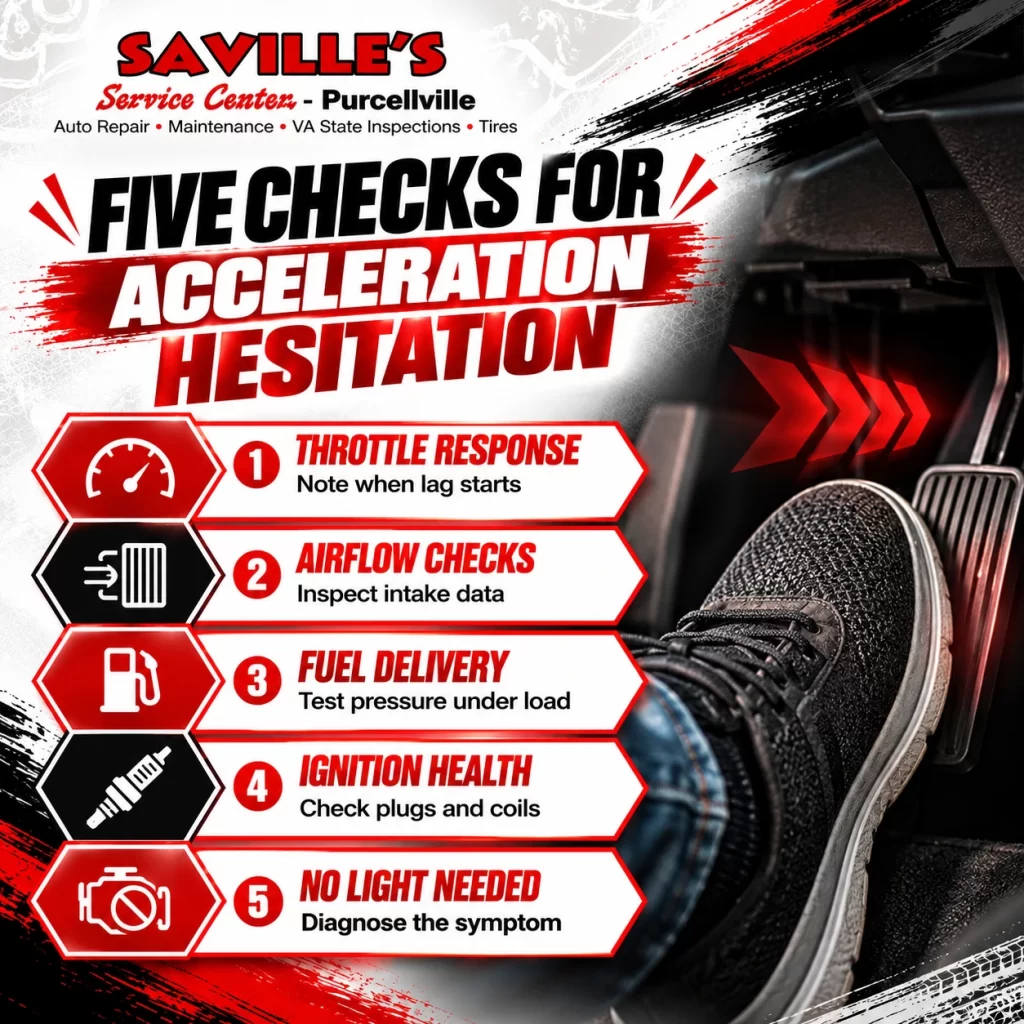
Low fuel pressure or restricted fuel flow can leave the engine short of fuel when you press the gas. A weak fuel pump, clogged filter, dirty injector, or pressure-control fault may allow normal idling yet cause a stumble under load. The problem may feel worse while climbing a hill or entering faster traffic.
Airflow and Throttle Problems
Incorrect airflow data can disturb the air-fuel mixture before the computer recognizes a clear fault. A dirty throttle body, air leak, restricted air filter, or inaccurate mass airflow sensor can cause a pause or surge. These problems may be more noticeable after a cold start or during the first few minutes of a trip.
Ignition Problems Under Load
A weak spark can become obvious only when cylinder pressure rises during acceleration. Worn spark plugs, damaged boots, or a failing ignition coil may cause a brief misfire without immediately setting a warning light. If testing finds a mechanical or ignition fault, our engine repair in Purcellville, VA, covers verified repairs after the cause is confirmed.
Transmission or Drivetrain Response
Not every delay comes from the engine. A transmission that hesitates before downshifting, slips as power increases, or engages late can feel like an engine stumble. Note whether engine speed rises without a matching increase in road speed because that detail may point the diagnosis toward the transmission.
What to Notice Before Scheduling Service
A few clear observations can help a technician reproduce the problem and choose the right tests. You do not need to diagnose the vehicle yourself, but the timing and conditions matter.
When and How the Hesitation Happens
Notice whether the pause happens from a stop, at highway speed, on hills, or only when the engine is cold. Purcellville drivers may first notice it while joining Route 7, moving from Route 9 into faster traffic, or climbing rolling roads in Western Loudoun. The Route 7 and Route 9 acceleration-lane improvements highlight how important predictable acceleration is at that local merge.
Other Symptoms That Appear With It
Record any rough idle, hard starting, fuel odor, unusual sound, or change in fuel use. Also note whether the tachometer jumps or the vehicle shudders. A short phone video of the gauges can be useful if it is captured safely by a passenger while the symptom occurs.
Why Professional Testing Matters
Professional testing separates similar symptoms before money is spent on parts. A technician can check pending codes, freeze-frame history, fuel trims, throttle position, airflow readings, misfire counts, and transmission data. Mechanical tests may then confirm fuel pressure, vacuum integrity, compression, or ignition strength.
Saville’s Service Center services all makes and models, including Chevrolet models supported through our Chevrolet repair and maintenance services. Model-specific data and test procedures matter because the same hesitation can come from different systems on a Silverado, Equinox, Malibu, or another vehicle.
Is It Safe to Keep Driving?
Mild, occasional hesitation may allow a careful trip to a shop, but worsening or severe hesitation can make merging and crossing traffic unsafe. Avoid hard acceleration and busy routes if the vehicle cannot respond predictably. Pull over and arrange assistance if it stalls, loses substantial power, begins shaking, overheats, smells strongly of fuel, or develops a flashing warning light.
For routine trips between Purcellville, Round Hill, Hamilton, and Leesburg, do not wait for the dashboard to confirm what you can already feel. Early testing can catch an intermittent fault while the symptom is easier to reproduce.
Takeaways
A missing warning light does not rule out a real drivability problem. Fuel pressure, airflow, ignition, and transmission faults can all create hesitation before a code turns on the light.
If your car hesitates when accelerating, note when it happens and any related symptoms. Schedule engine diagnostics in Purcellville, VA, before the delay becomes strong enough to affect safe merging or everyday driving.
Frequently Asked Questions
Why does my engine hesitate if no warning light is on?
Your engine may hesitate without a warning light because the fault is intermittent or has not crossed the computer’s limit for turning the light on. Live-data testing and mechanical checks can find problems that a basic code scan misses.
Can bad gas cause hesitation when accelerating?
Yes, contaminated fuel or fuel with the wrong octane can cause hesitation in some vehicles. If the symptom began soon after refueling, note the station and fuel grade. Have the fuel and delivery system tested before assuming the tank is the cause.
Can a dirty air filter make a car hesitate?
Yes, a heavily restricted air filter can reduce airflow and contribute to poor response under load. A technician should also inspect the intake path, throttle body, and airflow sensors because several faults can feel similar.
How is acceleration hesitation diagnosed?
Acceleration hesitation is diagnosed by reproducing the symptom and testing engine and transmission data under the same conditions. The process may include checking pending codes, fuel pressure, fuel trims, airflow, ignition output, vacuum leaks, and shift behavior.
Should I stop driving if the hesitation gets worse?
Yes, you should stop driving if worsening hesitation makes acceleration unpredictable or causes stalling, shaking, overheating, or a flashing warning light. Move to a safe location and arrange help rather than entering fast traffic with limited power.
Schedule Engine Diagnostics in Purcellville
If acceleration feels delayed or uneven, contact Saville’s Service Center to schedule an appointment. Our shop can reproduce the symptom, test the likely systems, and explain the findings before repair work begins.
Call (540) 338-5749 or visit us at 37251 E Richardson Ln, Unit B, Purcellville, VA 20132.